



2022 Hyundai Santa Cruz Pricing, Specs, and Review
2022 Hyundai Santa Cruz Pricing, Specs, and Review
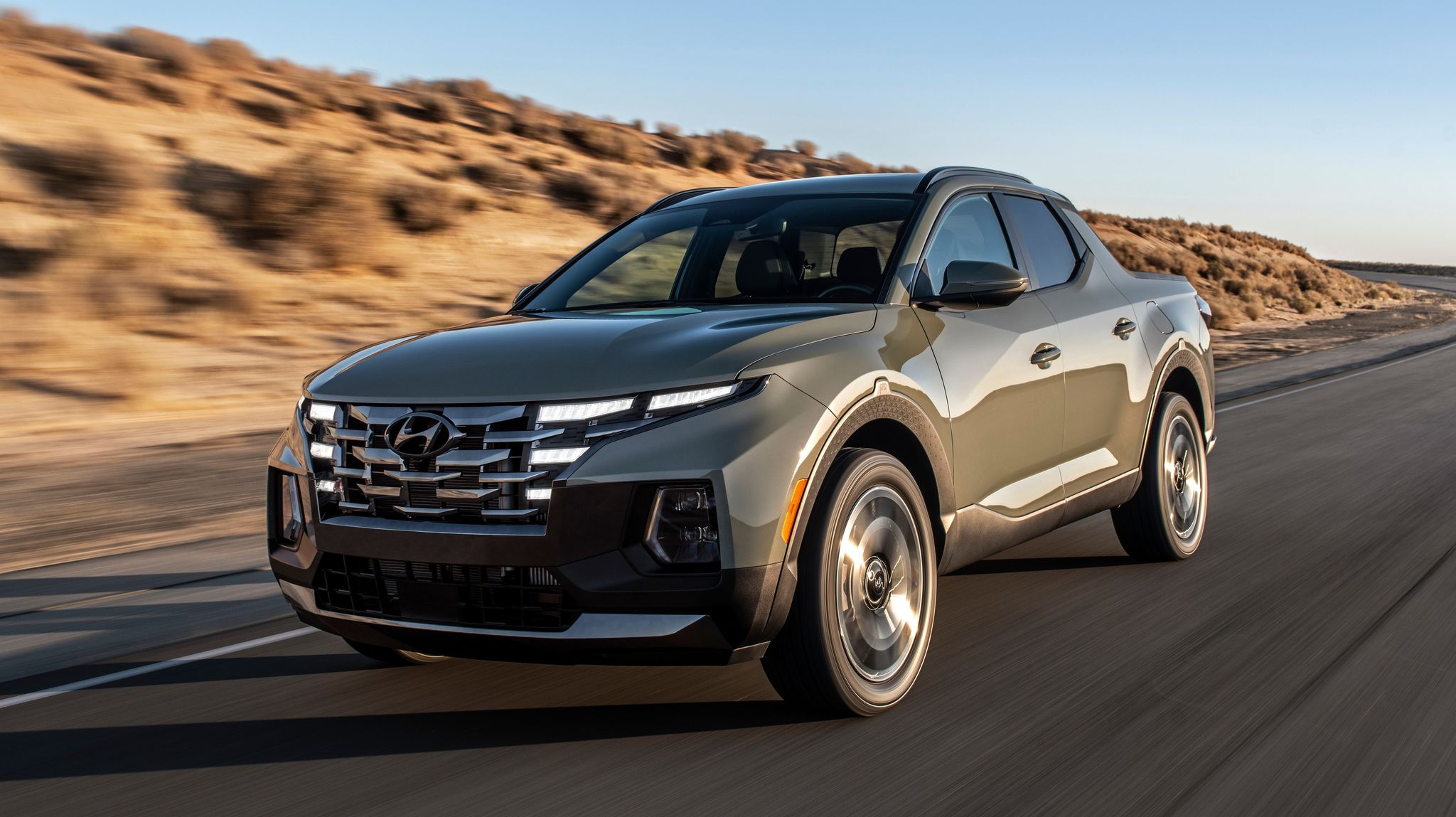
Don’t get it twisted: the new 2022 Hyundai Santa Cruz is a pickup truck. Its smaller proportions and unibody construction just mean it’s no full-size tow rig. Instead, think of the first Hyundai pickup as an alternative to the also unibody Honda Ridgeline, which too features a one size fits all crew cab, short-bed body style. The Santa Cruz certainly looks more distinct than the Honda–or any other mid-size truck, for that matter–with its interesting face and creased sheet metal.
Its interior also appears to be snazzier than its classmates, but the lack of physical controls (knobs and buttons) for the infotainment and HVAC systems, as well as what appears to be a small back seat, are question marks. Still, the 2022 Santa Cruz is a more functional twist on the tired crossover formula, and that open box on its butt means it qualifies as a pickup truck. If you are looking for a truck and a family vehicle this new truck is for you. If you are not into trucks then maybe look at the 2021 Hyundai Tucson or Santa Fe instead.
What’s New for 2022?
The idea of a Hyundai pickup truck has been around since the Santa Cruz concept was revealed at the 2015 Detroit auto show. That concept has become a reality as the Korean automaker has shown off the production version to the world. The 2022 Santa Cruz begins production at the Hyundai factory in Montgomery, Alabama in June and will go on sale this summer.
We are really enjoying this new sport adventure vehicle classified in the small pickups category and not quite out of the midsize pickups category into the full-size truck class, however the Santa Cruz will make you feel like you are inside a full-size pickup truck.
Pricing and Which One to Buy
Hyundai often prices its products below those of competitors, but this class of pickup trucks is more varied than other segments because of the configuration variables. With that said, we think the Santa Cruz could start in the mid-$20,000 range for a base model with the less powerful engine. That would make it considerably cheaper than the comparable Ridgeline, which only offers one body style and powertrain.
Engine, Transmission, and Performance
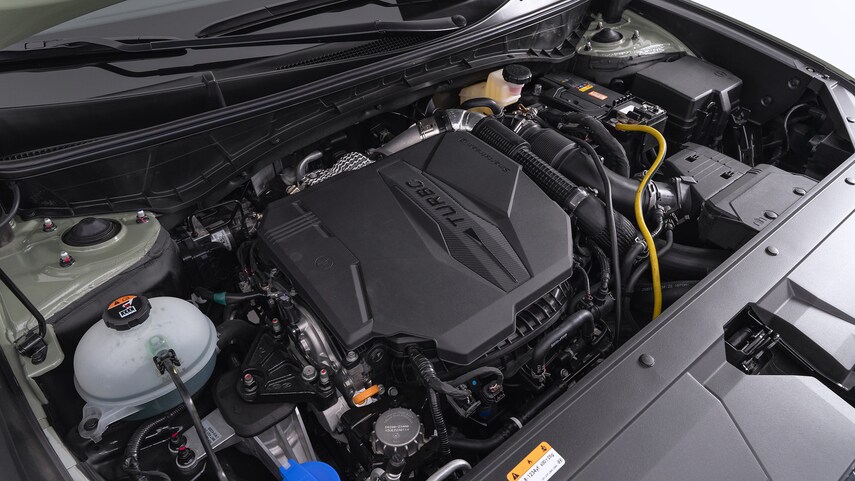
The Santa Cruz comes with two different powertrain choices. The standard setup is a 2.5-liter four-cylinder that should make more than 190 horsepower and 180 pound-feet of torque. The upgraded engine is a turbocharged 2.5-liter four with more than 275 horses and 310 pound-feet.
Both mate to eight-speed automatics, but the turbo option partners with the dual-clutch variety. All-wheel drive is also offered with both four-cylinders.
The Santa Cruz is shorter and lower than its segment rivals which, in theory, means it should be easier to maneuver. Hyundai also says its mid-size pickup is available with 18- or 20-inch wheels. The smaller dishes are said to offer taller sidewalls that are better suited for tackling rugged terrain.
Towing and Payload Capacity
Although the unibody Santa Cruz isn’t able to tow as much as its body on frame rivals such as the Jeep Gladiator and Toyota Tacoma, it can pull just as much as the only other unibody in this class, the Ridgeline. Both trucks are capped at a 5000-pound towing capacity, but that’s with the Hyundai’s more powerful turbocharged engine. The standard 2.5-liter four-cylinder is only rated to tug up to 3500 pounds.
Interior, Comfort, and Cargo Space
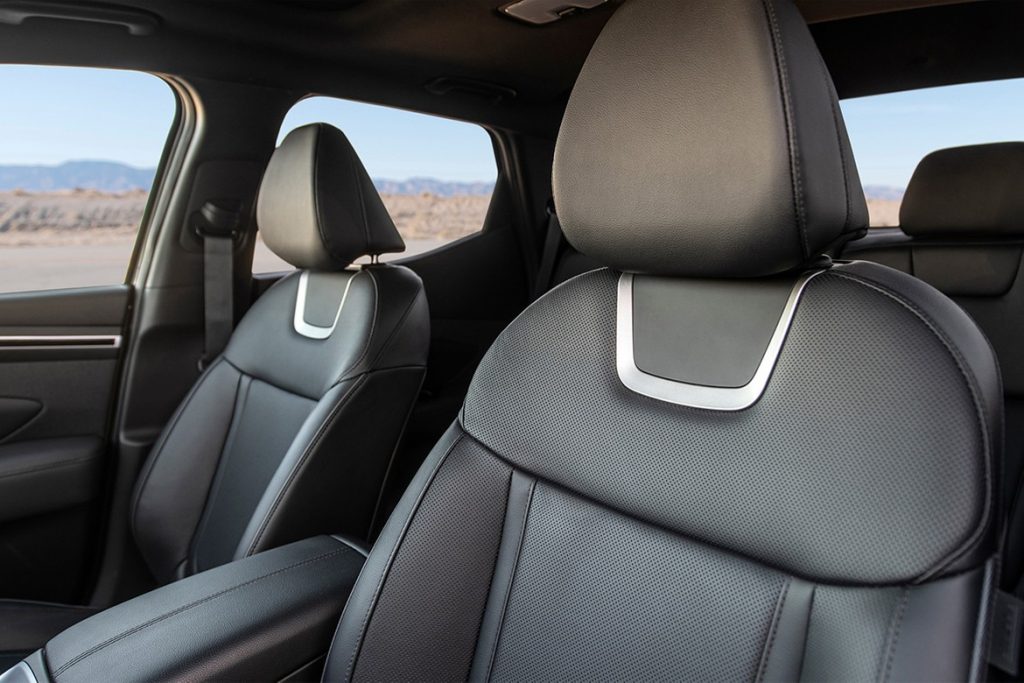
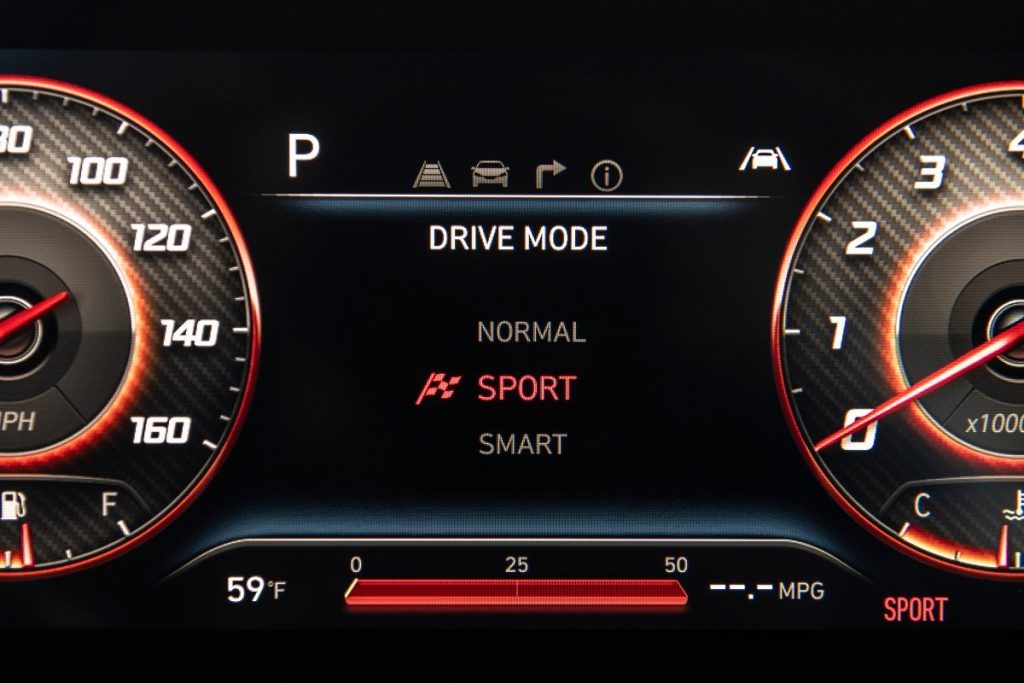
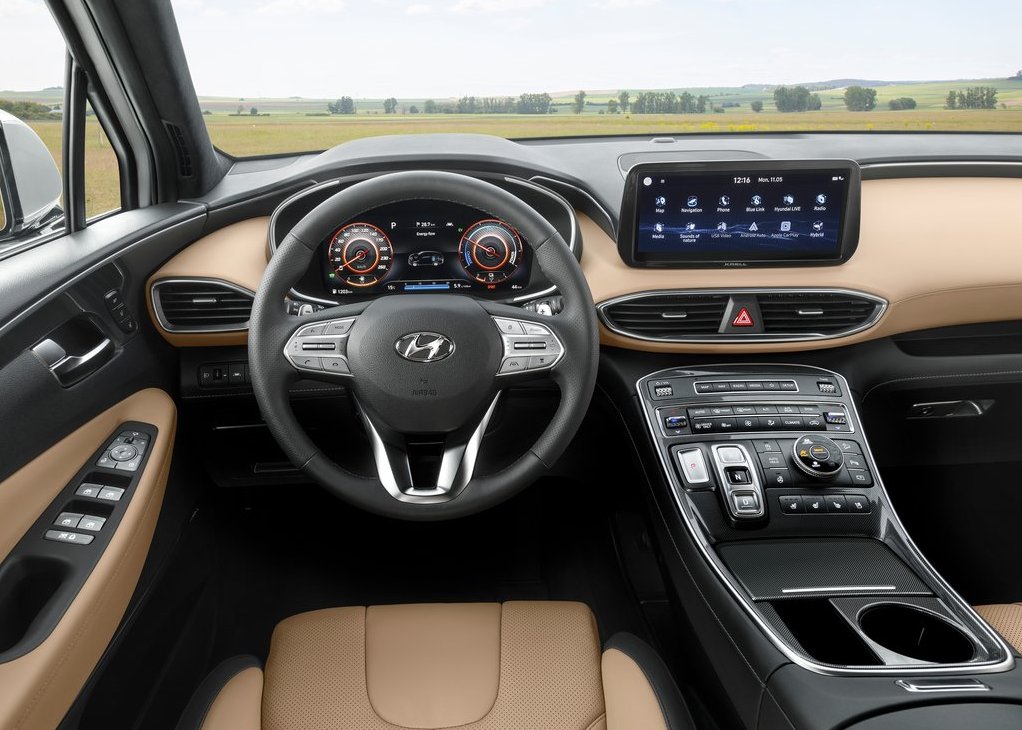
Inside, the Santa Cruz looks like it could have one of the nicest cabins among mid-size pickups. Hyundai has made a habit of building vehicles with attractive materials and desirable modern features that would look right in costlier vehicles. It’s the first truck in its class to offer a fully digital gauge cluster, and we appreciate that it has a traditional shifter on the center console instead of a finicky rotary knob or push-button setup.
While we know the Santa Cruz is only available with a four-door crew cab, we don’t know its exact interior dimensions, so we can’t say how its passenger space compares with rivals. However, the fact that its wheelbase is about 7 inches shorter than the Ridgeline’s suggests its back seat might not be particularly roomy.
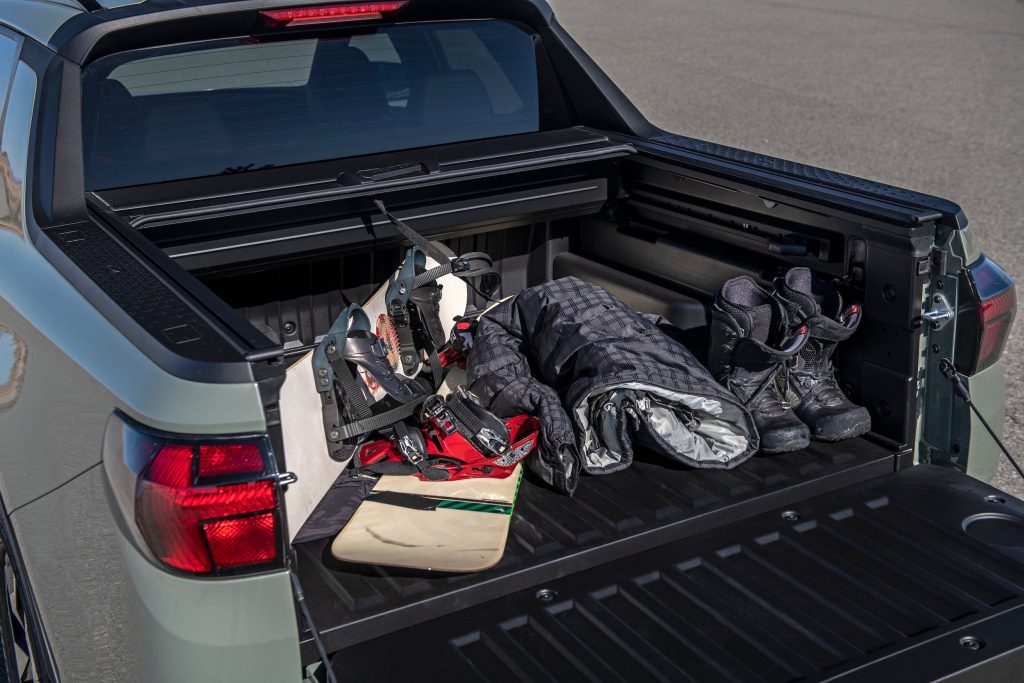
Likewise, its cargo bed looks to be one of the shortest in the segment at about four feet long. At least it has a lockable tonneau cover and a useful in-bed trunk that’s similar to what the Honda offers.
Infotainment and Connectivity
Hyundai ensures its pickup truck is outfitted with a contemporary infotainment system in the form of a standard 8.0-inch or an available 10.0-inch touchscreen. However, we think the company’s decision to omit any physical controls is a misstep. Along with wireless device charging, the Santa Cruz offers wireless pairing for both Apple CarPlay and Android Auto.
Those who want an upgraded stereo can opt for the eight-speaker Bose sound system. With Hyundai’s Blue Link services, which are provided free of charge for three years, users can start the truck, lock and unlock doors, and more remotely via the Internet, myriad apps, and even Amazon Alexa.
Safety and Driver Assistance Features
The Santa Cruz offers an array of driver assistance technology, including a standard driver attention warning and optional adaptive cruise control. For more information about the Santa Cruz’s crash-test results, visit the National Highway Traffic Safety Administration (NHTSA) and Insurance Institute for Highway Safety (IIHS) websites. Key safety features include:
- Standard forward collision warning and automated emergency braking
- Standard lane departure warning and lane-keeping assist
- Available blind-spot monitor and rear cross-traffic alert
Warranty and Maintenance Coverage
Hyundai—along with its corporate counterpart, Kia—has long offered one of the best warranty plans in the industry, with especially noteworthy powertrain coverage. The company also now offers complimentary scheduled maintenance that bests mainstream rivals such as Toyota.
- Limited warranty covers five years or 60,000 miles
- Powertrain warranty covers 10 years or 100,000 miles
- Complimentary maintenance is covered for three years or 36,000 miles
- Fuel Economy and Real-World MPG
2022 Hyundai Kona Pricing, Review, and Specs
2022 Hyundai Kona Pricing, Review, and Specs
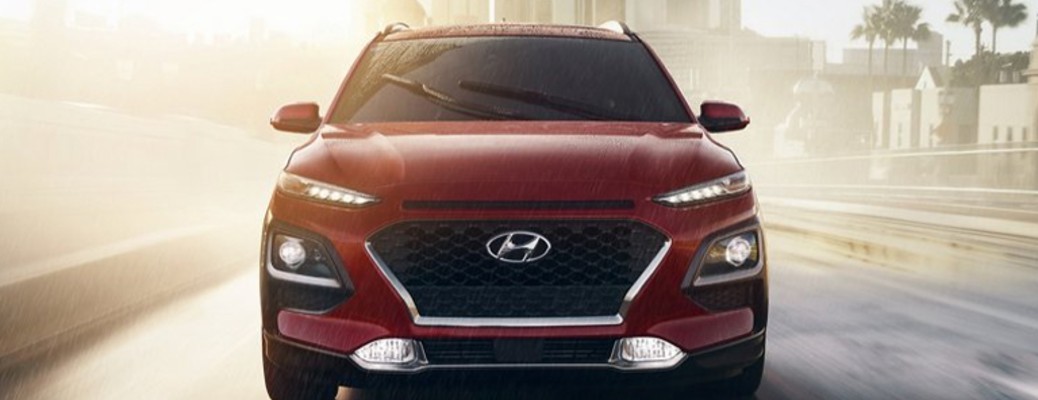
When an SUV delivers as crisp a driving experience as the 2022 Hyundai Kona, it’s hard to get hung up on the usual anti crossover sentiment—so we won’t. The subcompact Kona is, simply put, a great package that blends carlike on-road behavior with bold styling, a dose of practicality, and an elevated driving position. Two four-cylinder engines are offered: a 2.0-liter four, which is admittedly pretty poky, and a more desirable turbocharged 1.6-liter four that delivers a lot more punch.
Sticking to Hyundai’s value-forward approach, the Kona comes with a long list of standard features which only grows as you move through the more expensive trims—the top few of which get downright posh. The Kona is one of the smaller offerings in the subcompact SUV segment, so it gives up cargo and passenger space to some of its larger rivals, but we think the trade-off for the Hyundai’s compact package and fun-to-drive nature more than makes up for those shortcomings.
What’s New for 2022?
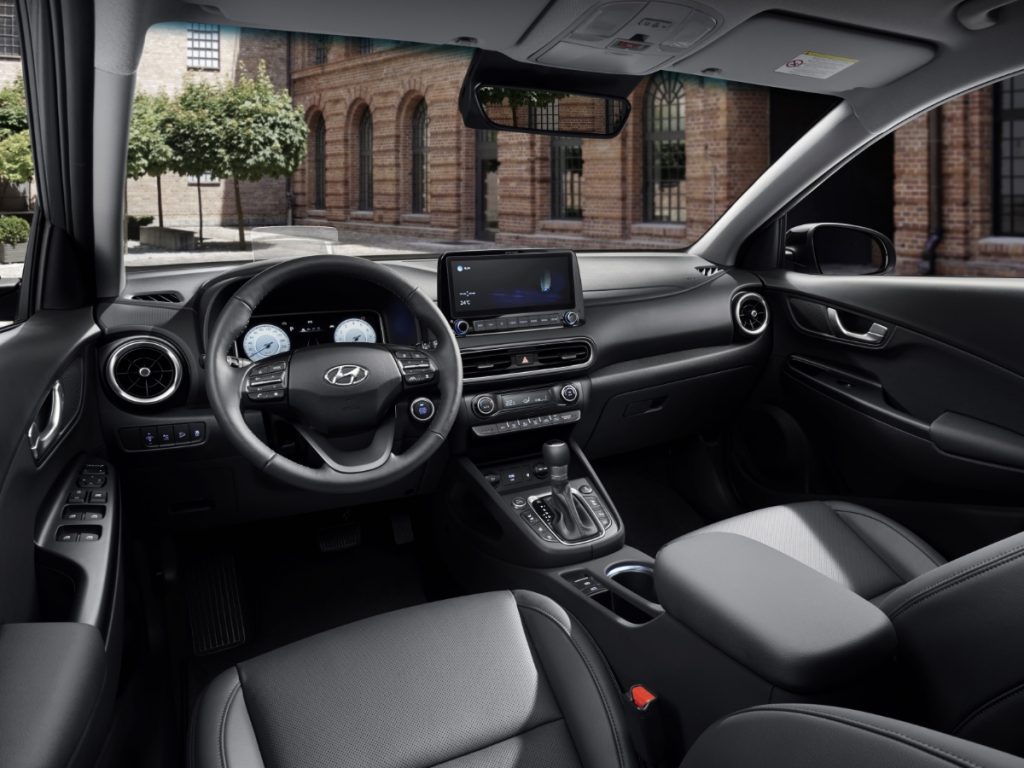
A lot, actually. Hyundai has given the Kona a refreshed exterior and interior for 2022, complete with a new front-end treatment that’s even more dramatic than the 2021 model. New wheel designs, updated exterior lighting elements, a new wide-mouth grille, and faux front and rear skid plates are all new styling features. Inside, the Kona receives a redesigned dashboard and a few new optional goodies, including a new digital gauge display, wireless smartphone charging, and heated rear seats.
The standard 7.0-inch infotainment touchscreen has grown to a larger 8.0-inch diameter, and a new 10.3-inch unit is now available as an upgrade. On top of all these changes, a sporty N Line trim has been added to the lineup with a 195-hp version of the turbocharged 1.6-liter engine; no word yet on the performance oriented N model that is expected soon.
Pricing and Which One to Buy
If it were our money, we’d spring for the nearly loaded Limited model, as it offers nearly all of the most sought-after equipment without being too expensive. Standard equipment includes a sunroof, automatic climate control, fog lamps, leather upholstery, and a power adjustable driver’s seat. Going with the Limited also gives us the spunky turbocharged four-cylinder engine and exterior styling that fairly mimics that of the top-spec Ultimate model, so no one will know you saved the extra cash.
Engine, Transmission, and Performance
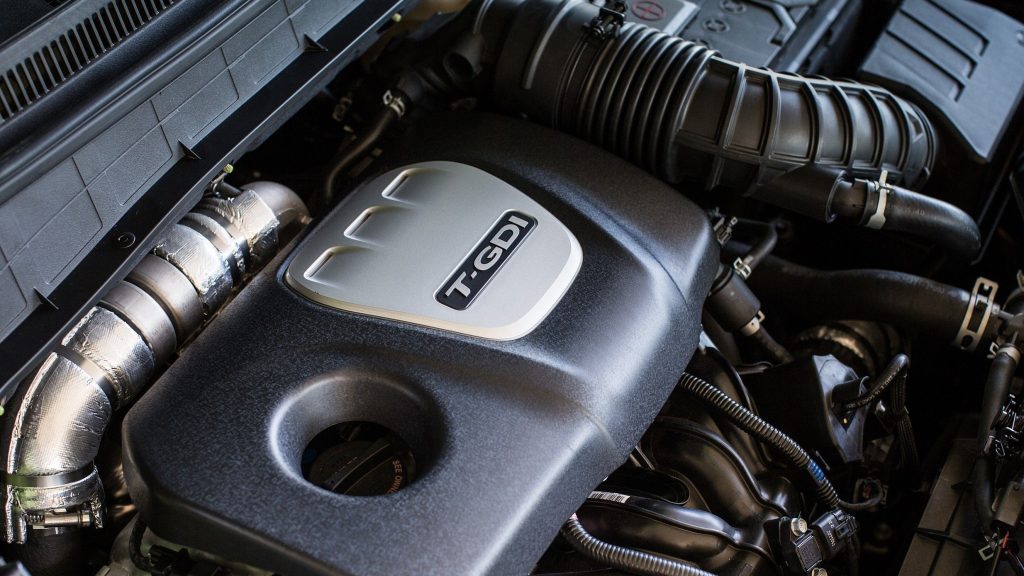
Two powertrains are available with the Kona: SE and SEL models come with a 147-hp four-cylinder and a six-speed automatic transmission. This setup could use a bit of caffeine; in our testing, an all-wheel-drive SEL model required 9.2 seconds to reach 60 mph. Limited and Ultimate models are powered by the considerably peppier 175-hp turbocharged four-cylinder paired to a seven-speed dual-clutch automatic; going with the N Line trim boosts power to 195 horsepower.
With the turbo-four, the 175-hp Kona Ultimate scampered from zero to 60 mph in 6.6 seconds, just 0.1 second behind the rapid Kia Soul Exclaim.
The seven-speed dual-clutch automatic shifts quickly and smoothly once you’re rolling, but it stumbles at low speed in parking lots and in bumper to bumper traffic, engaging and disengaging first gear hesitantly until the driver offers more throttle input. The Kona delivers agile handling and a surprising amount of fun.
This doesn’t translate to a rough ride over choppy roads; in fact, the suspension offers quite the opposite, damping out bumps and providing occupants with a cabin that is well isolated from pavement imperfections. The steering is perhaps the Kona’s biggest dynamic downfall: It’s an uncommunicative helm that, despite its heavy-weighted feel, requires frequent corrections when cruising the highway.
Fuel Economy and Real-World MPG
In this class of fuel-sipping mini-SUVs, the Kona’s EPA ratings are good but only average among its rivals. Despite this, the Kona impressed us during our real-world testing, besting much of its competition. With the turbocharged engine under the hood, the Kona delivered 32 mpg in our 200-mile highway fuel economy test; we managed 33 mpg with the base four-cylinder. For more information about the Kona’s fuel economy, visit the EPA’s website.
Interior, Comfort, and Cargo
Hyundai’s designers managed the tough task of bringing the charm of the Kona’s exterior design to the cabin while maintaining comfort and convenience. Quality materials, good ergonomics, and comfortable seats feel grown up and refined but not out of step with the Kona’s crazy but fun outward appearance. The steering wheel is wrapped with nicely grained leather with contrast stitching and offers integrated controls for cruise control and audio settings.
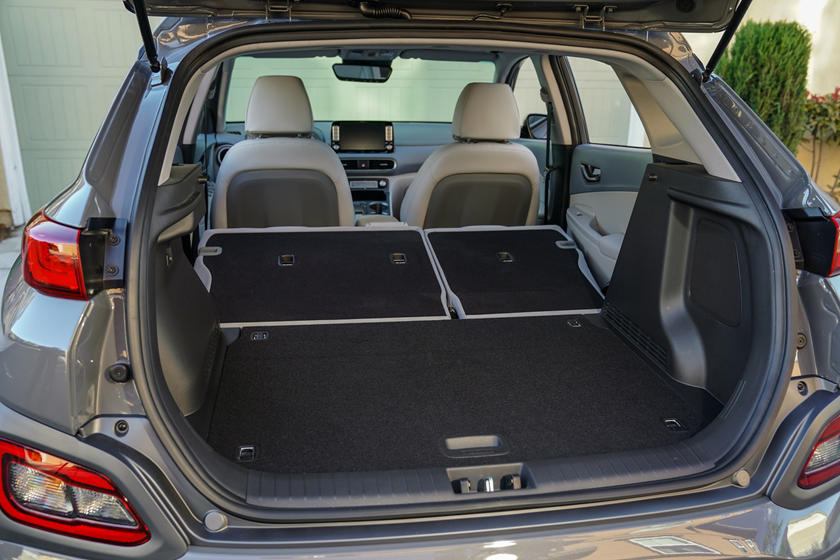
Those upgrading from a compact hatchback or sedan will find the Kona’s cargo space perfectly suitable, but buyers downsizing from a larger SUV will most likely feel the pinch. The Kona narrowly beat the pipsqueak Mazda CX-3 in our testing to see how many carry-on suitcases could fit. The Kona managed to hold 14 of our carry-on suitcases—two more than the CX-3 but eight fewer than the Honda HR-V.
Infotainment and Connectivity
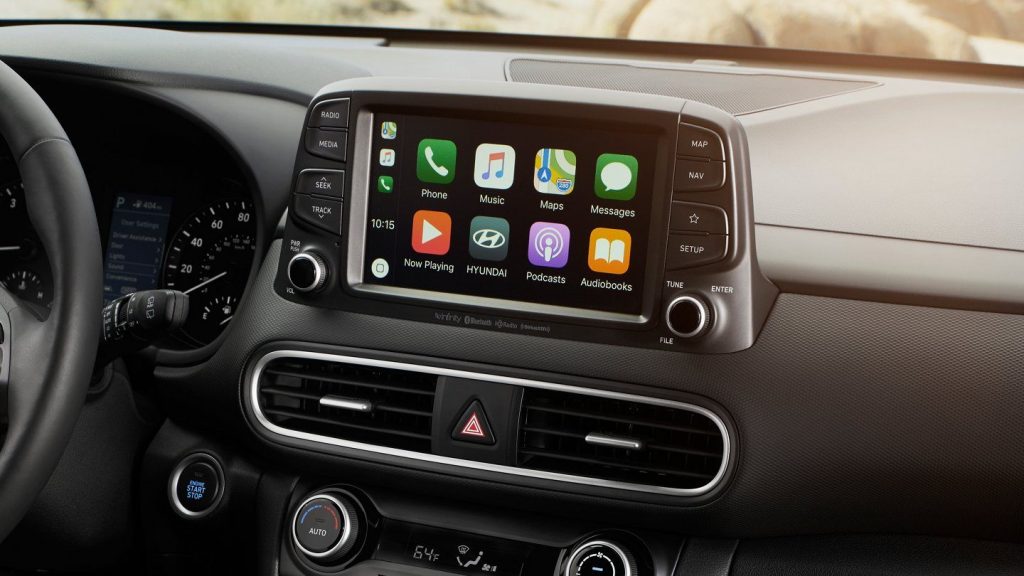
Standing atop the Kona’s dashboard is a touchscreen infotainment system flanked by simple shortcut buttons that allow you to easily switch between common menus. We found the system to be intuitive in its operation but leisurely when responding to inputs. An 8.0-inch touchscreen is standard, but buyers wanting a larger display can upgrade to a 10.3-inch unit.
Driving directions can be projected onto the Ultimate’s head-up display that flips up from the dashboard and also shows the vehicle’s speed and other information. Apple CarPlay and Android Auto capability are standard, with a wireless connection for such features available as an option.
Safety and Driver Assistance Features
Buyers searching for popular driver assistance features will find them on the Kona, which offers automated emergency braking, lane-keeping assist, and a driver attention monitor as standard equipment. Other more advanced features are still optional. For more information about the Kona’s crash-test results, visit the National Highway Traffic Safety Administration (NHTSA) and Insurance Institute for Highway Safety (IIHS) websites. Key safety features include:
- Standard automated emergency braking
- Standard lane departure warning
- Available automatic high-beam headlamps
Warranty and Maintenance Coverage
By now, Hyundai’s 10-year powertrain warranty is well known in the automotive industry as being one of the most generous policies available, and the Kona receives the same coverages as the rest of the lineup. The company also now offers complimentary scheduled maintenance that bests mainstream rivals such as Toyota.
- Limited warranty covers 5 years or 60,000 miles
- Powertrain warranty covers 10 years or 100,000 miles
- Complimentary maintenance covers 3 years or 36,000 miles
Connect with us


Recent Blog Entries
Categories
Wallace Hyundai
Address
3801 SE Federal Highway
Stuart, FL 34997
Phone
- Sales 772-283-6000
- Service 772-283-6000
- Parts 772-283-0687
| Monday | 9:00AM - 8:00PM |
| Tuesday | 9:00AM - 8:00PM |
| Wednesday | 9:00AM - 8:00PM |
| Thursday | 9:00AM - 8:00PM |
| Friday | 9:00AM - 7:00PM |
| Saturday | 9:00AM - 6:00PM |
| Sunday | 11:00AM - 5:00PM |
| Monday | 7:30AM - 5:30PM |
| Tuesday | 7:30AM - 5:30PM |
| Wednesday | 7:30AM - 5:30PM |
| Thursday | 7:30AM - 5:30PM |
| Friday | 7:30AM - 5:30PM |
| Saturday | 8:00AM - 1:00PM |
| Sunday | Closed |
| Monday | 7:30AM - 5:30PM |
| Tuesday | 7:30AM - 5:30PM |
| Wednesday | 7:30AM - 5:30PM |
| Thursday | 7:30AM - 5:30PM |
| Friday | 7:30AM - 5:30PM |
| Saturday | 8:00AM - 1:00PM |
| Sunday | Closed |

Your Premier Hyundai Dealership for the Treasure Coast Lifestyle
At Wallace Hyundai, we know that life in Stuart, Fort Pierce, Jupiter, and Port St. Lucie happens outdoors. Whether you're hauling a center console to the St. Lucie Inlet, packing the family for a beach day on Hutchinson Island, or commuting to work on I-95, we provide the comfort and utility to do it right. Our Fort Pierce showroom isn't just a place to buy a car—it’s where your next weekend adventure begins with a new Hyundai SUV or a fuel efficient new Hyundai Sedan. Wallace Hyundai has not only the best selection of affordable new and or a fuel efficient used vehicles for all Florida lifestyles, but the friendliest staff and helpful customer service.
Vehicles with the Capability & Reliability You Need for Fun in the Sun
In Florida, a vehicle is a tool for your lifestyle. We specialize in the comfortable ride and utility you expect, like the Hyundai Santa Fe for an enjoyable ride with friends on a night out to dinner at one of the many fine restaurants restaurants in Stuart or Jensen Beach. Weekend adventures to Miami or the theme parks in Orlando are effortless in the Hyundai Palisade with enough cargo room and 3 rows of comfortable seating. The Hyundai lineup also has more fuel efficient SUVs for the daily commute with the Hyundai Tucson Hybrid and the Hyundai Ioniq 5 EV. Whatever your needs, Hyundai has a SUV or sedan built for comfort in the Florida heat and humidity.
More Time at the Sandbar, Less at the Dealer
We know you’d rather be out at the Stuart Sandbar than sitting in a showroom. That’s why we’ve streamlined our entire process. Use our 2026 digital retail tools like our finance application, payment calculator, or value your trade to get an instant, data-backed cash offer for your trade and customize your monthly payments from your phone. Our goal is a transparent, frictionless hand-off so you can get your new vehicle home and your toys back on the water.
Hyundai Service in Stuart Built for Salt & Sun
Living near the ocean means your vehicle faces salt air, intense UV rays, and heavy towing demands. Our factory-trained technicians don't just "change oil"—they maintain the integrity of your drivetrain. Using genuine Hyundai parts, we ensure your Hyundai's cooling system, brakes, and electrical components are ready for the stress of driving through Florida summers, keeping you reliable for every mile. No matter the fix, our service team gets you in and out, ready to hit the road. Give us a call or use our convenient service scheduler right here online to lock in your appointment! From workdays in Port St. Lucie to weekends in Stuart or Jupiter, Wallace Hyundai is proud to be the Treasure Coast’s go-to for power, utility, and premium SUVs and cars. Visit us on Federal Hwy in Stuart today and find the SUV or fuel efficient sedan that’s ready to keep up with your lifestyle. Let's get you on the road—and the water—faster.